Students examine a plastic "surface" graph of the gravitational potential energy of a Earth-satellite system to make connections between gravitational force and gravitational potential energy.
Students examine a plastic “surface” graph of the gravitational potential energy of an Earth-satellite system to explore the properties of gravitational potential energy for a spherically symmetric system.
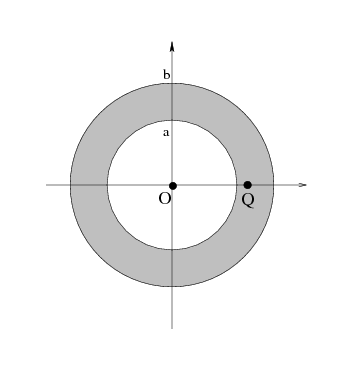
The gravitational field due to a spherical shell of matter (or equivalently, the
electric field due to a spherical shell of charge) is given by:
\begin{equation}
\vec g =
\begin{cases}
0&\textrm{for } r<a\\
-G \,\frac{M}{b^3-a^3}\,
\left( r-\frac{a^3}{r^2}\right)\, \hat r & \textrm{for } a<r<b\\
-G\,\frac{M}{r^2}\, \hat r & \textrm{for } r>b \\
\end{cases}
\end{equation}
This problem explores the consequences of the divergence
theorem for this shell.
Using the given description of the gravitational field, find the divergence of the
gravitational field everywhere in space. You will need to divide this
question up into three parts: \(r<a\), \(a<r<b\), and \(r>b\).
Briefly discuss the physical meaning of the divergence in this particular
example.
For this gravitational field, verify the divergence theorem on a
sphere, concentric with the shell, with radius \(Q\), where \(a<Q<b\).
("Verify" the divergence theorem means calculate the integrals from both sides of the divergence theorem and show that they give the same answer.)
Briefly discuss how this example would change if you were discussing the
electric field of a uniformly charged spherical shell.
Found in: Static Fields, AIMS Maxwell, Problem-Solving course(s)
Consider a column of atoms each of mass \(M\) at temperature \(T\) in
a uniform gravitational field \(g\). Find the thermal average
potential energy per atom. The thermal average kinetic energy is
independent of height. Find the total heat capacity per atom. The
total heat capacity is the sum of contributions from the kinetic
energy and from the potential energy. Take the zero of the
gravitational energy at the bottom \(h=0\) of the column. Integrate
from \(h=0\) to \(h=\infty\). You may assume the gas is ideal.
(Quick) Purpose: Recognize the definition of a central force. Build experience about which common physical situations represent central forces and which don't.
Which of the following forces can be central forces? which cannot? If the force CAN be a central force, explain the circumstances that would allow it to be a central force.
The force on a test mass \(m\) in a gravitational field \(\vec{g~}\),
i.e. \(m\vec g\)
The force on a test charge \(q\) in an electric field \(\vec E\), i.e.
\(q\vec E\)
The force on a test charge \(q\) moving at velocity \(\vec{v~}\) in a
magnetic field \(\vec B\), i.e. \(q\vec v \times \vec B\)
(Use the equation for orbit shape.) Gain experience with unusual force laws.
In science fiction movies, characters often talk about a spaceship “spiralling in” right before it hits the planet. But all orbits in a \(1/r^2\) force are conic sections, not spirals. This spiralling in happens because the spaceship hits atmosphere and the drag from the atmosphere changes the shape of the orbit. But, in an alternate universe, we might have other force laws.
In class, we discussed how to calculate the shape of the orbit for an inverse square potential. More generally, the equation for the orbit of a mass \(\mu\) under the influence of a central force \(f(r)\) is given by:
\begin{align}
\frac{d^2 u}{d\phi^2} + u &=-\frac{\mu}{\ell^2}\frac{1}{u^2}f\left(\frac{1}{u}\right)\\
\Rightarrow f\left(\frac{1}{u}\right)&=-\frac{\ell^2}{\mu}u^2
\left(\frac{d^2 u}{d\phi^2} + u\right)
\end{align}
where \(u=r^{-1}\).
Find the force law for a mass \(\mu\), under the influence of a central-force field, that moves in a logarithmic spiral orbit given by \(r = ke^{\alpha \phi}\), where \(k\) and \(\alpha\) are constants.
The spring constant \(k\) for a one-dimensional spring is defined by:
\[F=k(x-x_0).\]
Discuss briefly whether each of the variables in this equation is intensive, extensive, or inverse of extensive.
Students consider projectile motion of an object that experiences drag force that in linear with the velocity. Students consider the horizontal motion and the vertical motion separately. Students solve Newton's 2nd law as a differential equation.
Students need to understand that the surface represents the electric potential in the center of a parallel plate capacitor. Try doing the activity Electric Potential of Two Charged Plates before this activity.
Students should know that
objects with like charge repel and opposite charge attract,
object tend to move toward lower energy configurations
The potential energy of a charged particle is related to its charge: \(U=qV\)
The force on a charged particle is related to its charge: \(\vec{F}=q\vec{E}\)
Students consider the relation (1) between the angular momentum and magnetic moment for a current loop and (2) the force on a magnetic moment in an inhomogeneous magnetic field. Students make a (classical) prediction of the outcome of a Stern-Gerlach experiment.